8 GOLDEN HELMET CHAMPIONSHIPS (8 > > >11) p.GH1
8.1 The First Golden Helmets, - Australia
8.2 Pre-War English & Scottish GHs & SHs
8.3 South American Gold & Silver Helmets
8.4 Gold Helmets: Europe and Wider
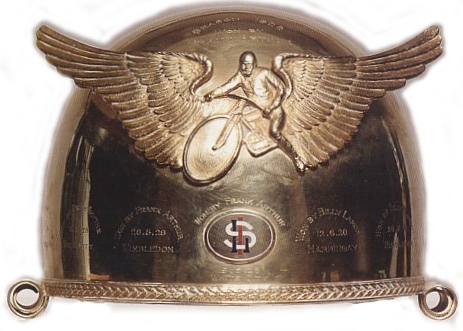
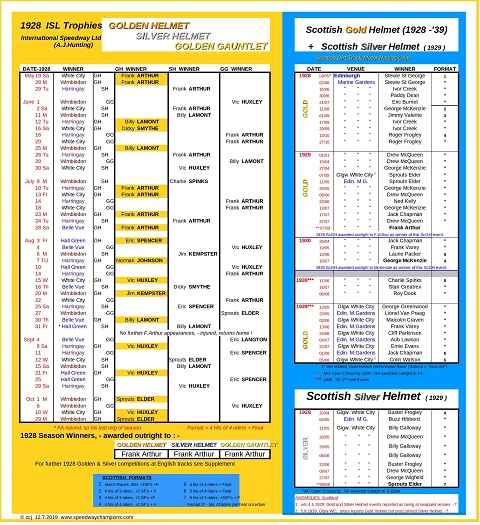
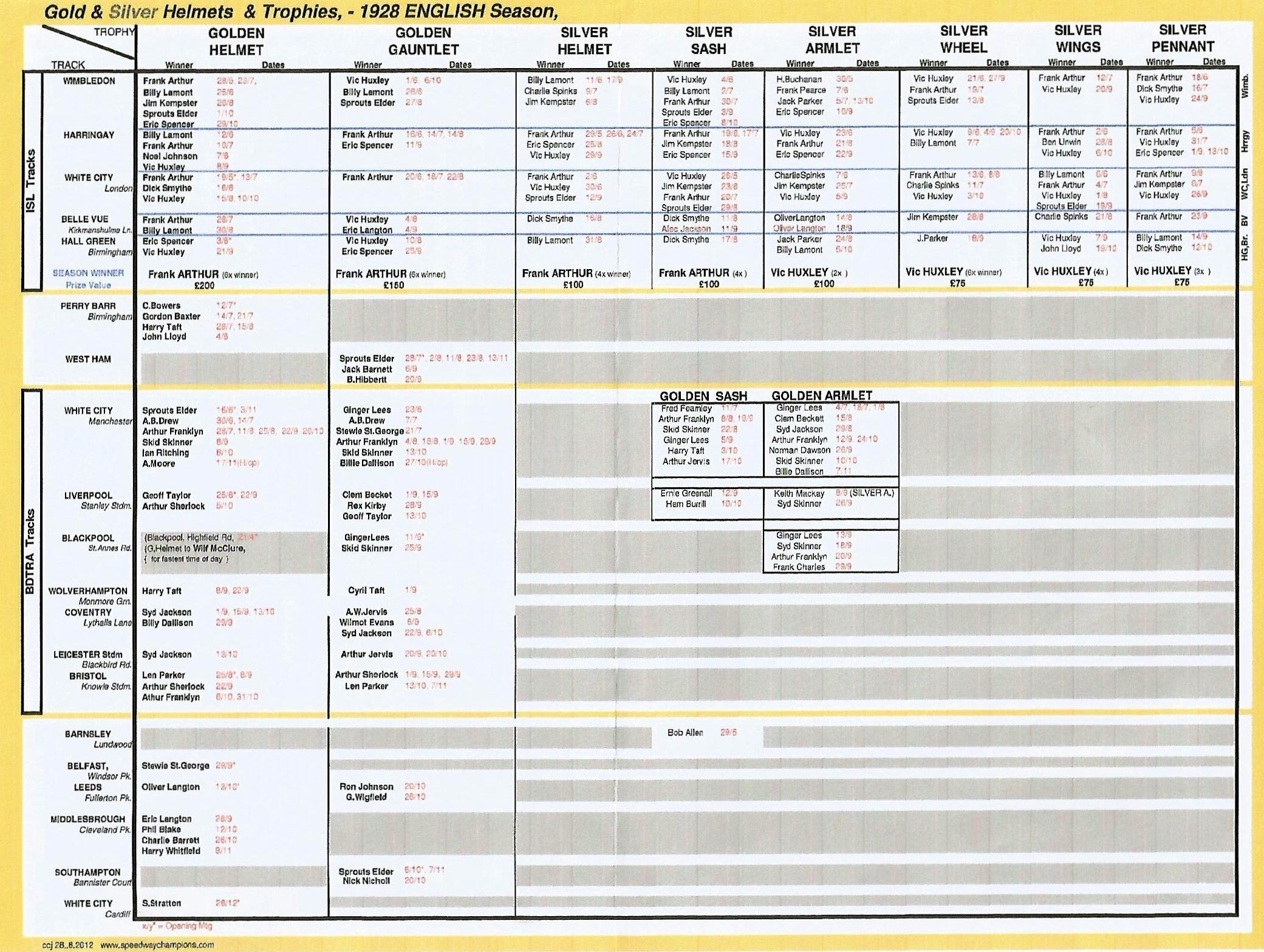
Golden Helmets, as well as Silver Helmets, Golden Gauntlets, etc, were often presented as trophies to competition winners at many tracks by the promotional companies during the first days of speedway in the late ‘20s and early ‘30s as 2-man match races between the star riders were extremely popular with the large crowds of the boom years. They were a coveted prize: some were gilt, some silver plate, many assay-marked, a few the real thing. At an auction sale in 2004 in Australia the trophies of Frank Arthur included several hall-marked silver helmets, a 9-carat gold Golden Gauntlet and 9-carat Golden Helmet, (above rt,) which alone sold for $A10,000.
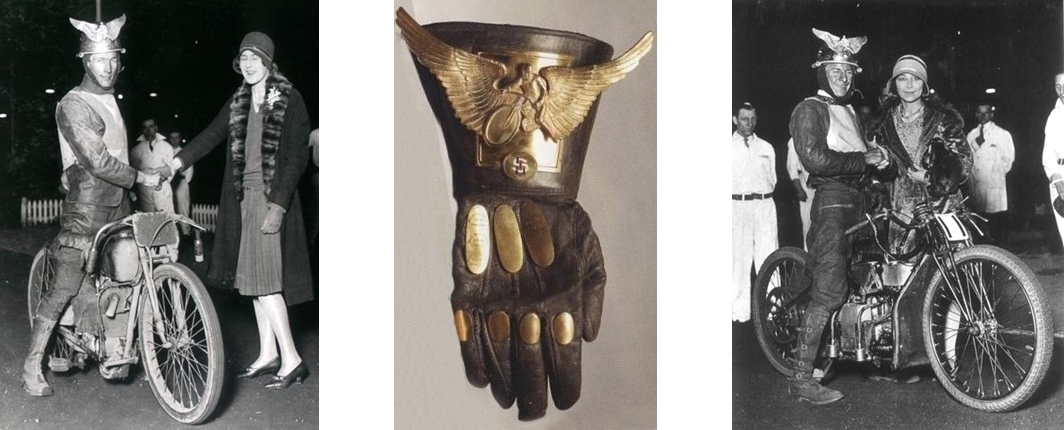
Golden Helmet, 1928 Silver Helmet, 1929
The First Golden Helmets - Australia
- 1920s
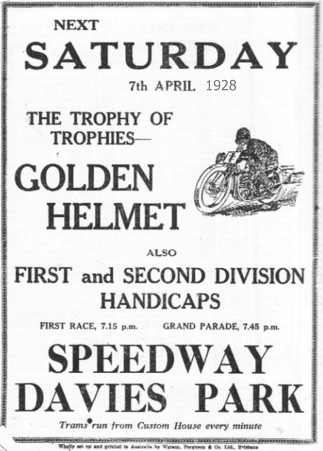
The practice of racing for valuable speed/race-linked trophies started in Australia, where A.J.Hunting and his Olympia Speedway companies presented gold and silver trophies across the wider range of 'speedway' motor sports starting in 1925 with the Maroubra Golden Helmet at the steeply-banked 1-mile concrete bowl, Maroubra Speedway outside Sydney NSW. Winners included Cecil Brown (6x) and Sprouts Elder, (5x) as American riders dominated. Hunting extended his ventures to dirt tracks in Queensland with the opening in 1926 of Brisbane Exhibition Ground Speedway (the “Ekka”), followed by Davies Park Brisbane in 1927..
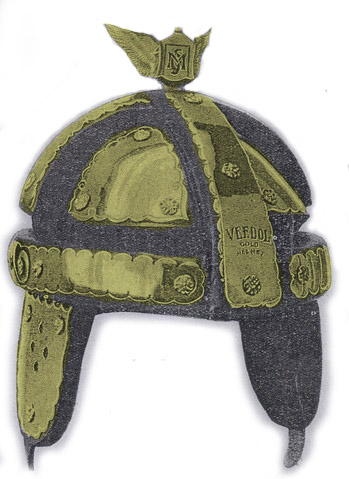
 From their oil-company
sponsors the Ekka GHs were known as the 'Veedol Golden Helmet',
(1926/27, left,) and the 'Castrol Golden Helmet' (1932 -'38); at
Davies Park the GH became known as the 'ACUQ. GH' (Auto-Cycle Union
of Queensland,) and was raced for extensively between 1927 and 1931
when holders included Vic Huxley, Frank Arthur, Billy Lamont, Dicky
Smythe, etc. amongst a role call of over 40 defences. A list of all
winners can be seen in the table below, (noting that there were also
Golden Helmet events subsequently staged at most other speedway
promotions such as were operating at Sydney NSW, Perth WA, Melbourne Vict. and Adelaide SA: see Supplement.)
From their oil-company
sponsors the Ekka GHs were known as the 'Veedol Golden Helmet',
(1926/27, left,) and the 'Castrol Golden Helmet' (1932 -'38); at
Davies Park the GH became known as the 'ACUQ. GH' (Auto-Cycle Union
of Queensland,) and was raced for extensively between 1927 and 1931
when holders included Vic Huxley, Frank Arthur, Billy Lamont, Dicky
Smythe, etc. amongst a role call of over 40 defences. A list of all
winners can be seen in the table below, (noting that there were also
Golden Helmet events subsequently staged at most other speedway
promotions such as were operating at Sydney NSW, Perth WA, Melbourne Vict. and Adelaide SA: see Supplement.)
The usual practice,
in Australia then and later in England after Hunting's arrival in
1928 and the setting up of ISL (International Speedway Ltd.), -
though there were variations with time and amongst other promotions -
, was that the race winner, as holder, received weekly paid prize
money whilst he continued to defend his title, - £15/wk initially at
Maroubra, (equivalent to £750/wk in present day terms,) £5/wk at
Ekka in 1926 - , and the valuable gold or silver trophy was then
awarded outright at the end of the season to the top point-scorer.
Such a regular monetary element was copied (but monthly) post-war to
the British GH MRC when it was introduced in 1946, and the
end-of-season holder continued to receive a reduced figure throughout
the winter.
Tb.8a/b/c Click sections below for full-size up-to-date tables.-
a) Aust. A.J.Hunting; b) Aust. pre-War Other; c) Aust. post-War; d) NZ pre-War,(+post.)

ISL track programmes,
B'ham Hall Green Belle Vue Harringay White City, London
1928 1928 1929 1929 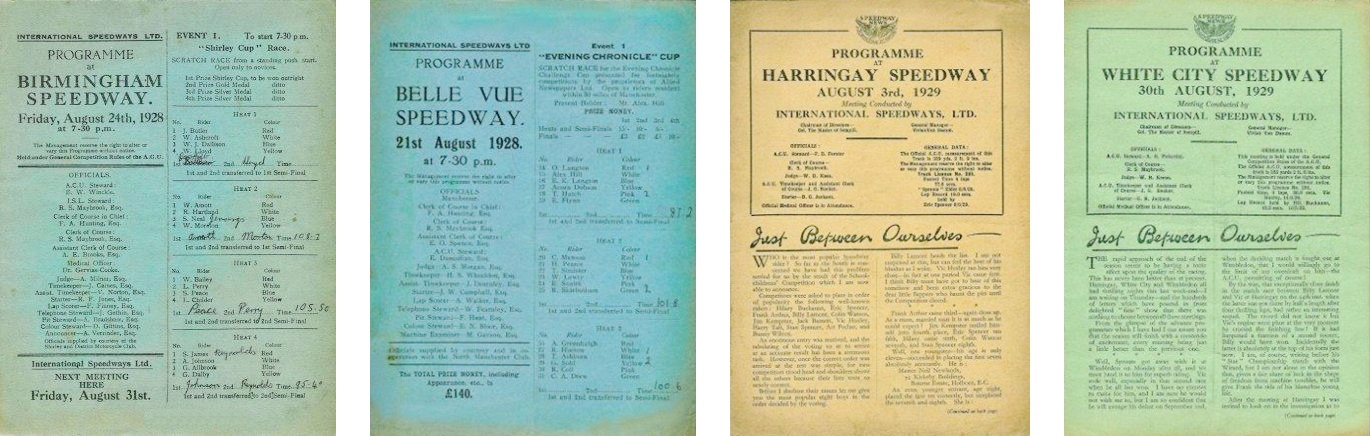
- Scottish Gold Helmet,
- Scottish Silver Helmet
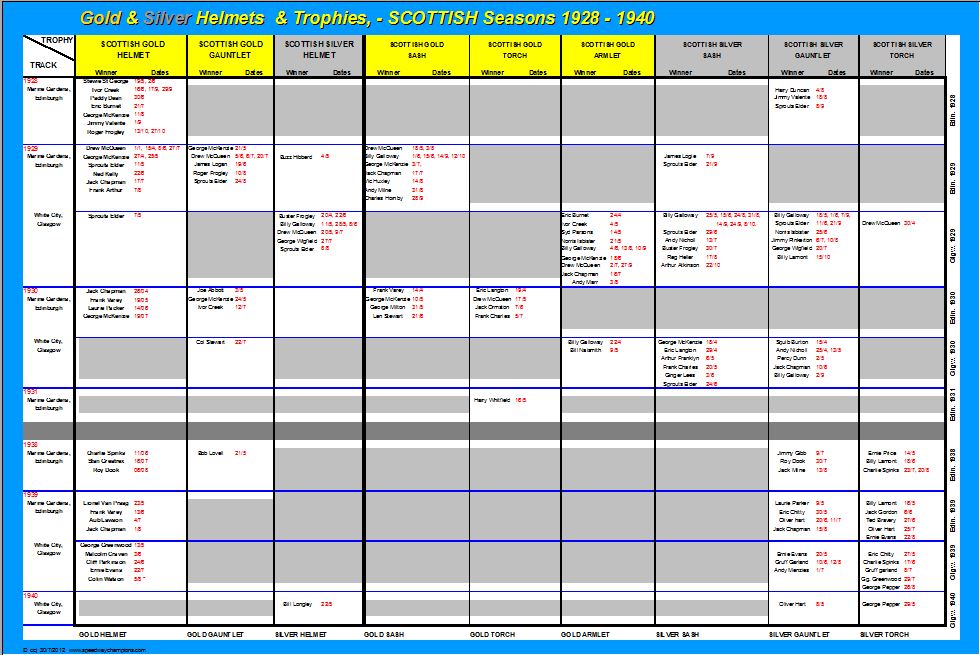
In two phases between 1928 and 1939 races for the 'Scottish
Gold Helmet' were held regularly at Marine Gardens Edinburgh and also in '39
at Glasgow White City, (see detail via image-link above.)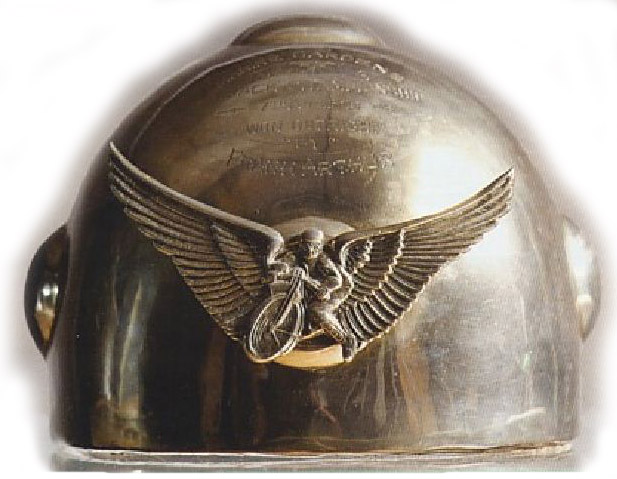
The first ever dirt track meeting at Edinburgh's Marine Gardens in May 1928 featured the 'Gold Helmet International Race'. A series of Match Races run over 4 heats, 2 Semi-finals and a 6-lap Final, it was won by New Zealander Stewie St George from Drew McQueen. For the following and all subsequent stagings the helmet was termed the 'Scottish Gold Helmet' and was raced for on 10 further occasions that year, progressing from match races then to 3-man and thereafter 4-heat, 4-man races. A new Golden Helmet was put up in 1929 (left,) when McQueen was successful on 4 occasions but the helmet was awarded outright to Frank Arthur when he took the Marine Gardens Track Championship in August '29. (This trophy, seen left, was a sterling silver 'gold' helmet and was sold at auction in Sydney in 2004 along with other Arthur trophies.)
In the same year a short-lived Scottish Silver Helmet contest was competed for at Glasgow White City. At both venues the Helmet events alternated with Silver Gauntlet, (Ed.MG '28), Gold Sash, Gold Gauntlet, Silver Sash (Ed.MG '29), Gold Armlet, Silver Torch, Silver Gauntlet, Silver Sash, (Gl.WC), Gold Sash, Gold Torch, Gold Gauntlet, (Ed.MG '30). A new third Gold Helmet was presented in 1930 which on the fourth occasion raced for, on July 19th, was awarded outright to George McKenzie, and which today can be viewed at the Scottish Speedway Museum outside Edinburgh.
It was 1938 before a Scottish Gold Helmet was again competed for, when speedway returned to the capital. The event continued in 1939, when both venues, Edinburgh Marine Gardens and Glasgow White City staged races for a Scottish Gold Helmet, but in this period it was visiting English and Australian stars who took the glory.
n.b. Post-war a
Scottish Match Race Championship was contested, (1949-'53, and
1964-'76: see Br.MRC page,) but did not involve Helmet trophies. In
more recent times a new Scottish Gold Helmet, the Heathersfield GH
trophy, was created in classic style and contested initially in 1997
for an 'Open' Linlithgow competition at Conference Lge. level, (see
Supplement, p.GH 2.)
Edinburgh 1928 Glasgow 1929 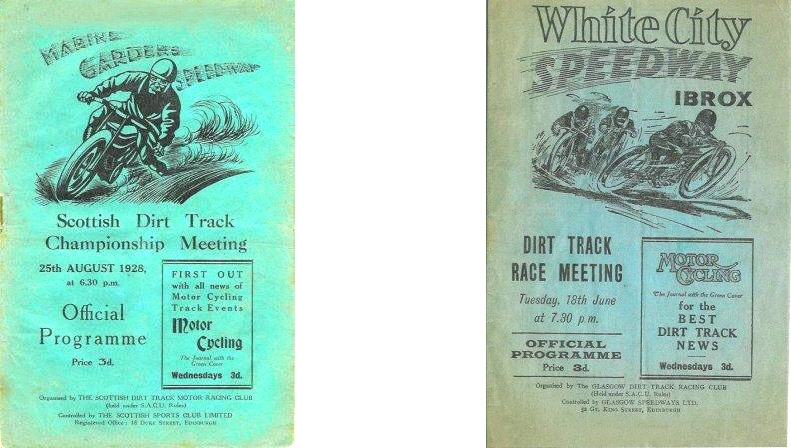
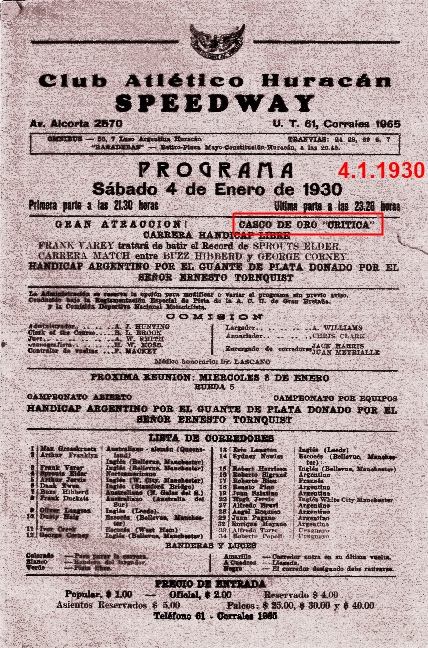
8.3
South America 1929-'31
After the UK, Hunting
went to South America and set up a number of similar high value
trophies which were raced for in their 2 operational seasons, - at
Huracan stadium in Buenos Aires and at River Plate Speedway also in
B.A. The 'Casco de Oro', - Golden Helmet - , was sponsored by the
Buenos Aires newspaper 'Critica', and raced for over 4-man scratch
heats, semi's and a final, as were the Silver and Bronze Helmet
trophies. Sprouts Elder gained the most successes over a squad of
chiefly British riders, (as well as in the World's Championship
series,) most of ISL's Aussie contingent having chosen to return home
for the UK winter, though late season appearances by Max Grosskreutz
(1930,) Ernie Evans, Dicky Wise and 'Cyclone' Billy Lamont (1931,)
added to the fare.
Lamont's Silver
Helmet, seen below, with inscription, was auctioned in Melbourne in Oct. 2015, along with the
similar red 'Enamel Helmet' (below rt.) and other trophies acquired during his
racing career. The solid silver helmet fetched over $A10,000, the red
enameled brass $A4,000, (and his 1931 silver-plated World
Championship trophy $A2,440.)
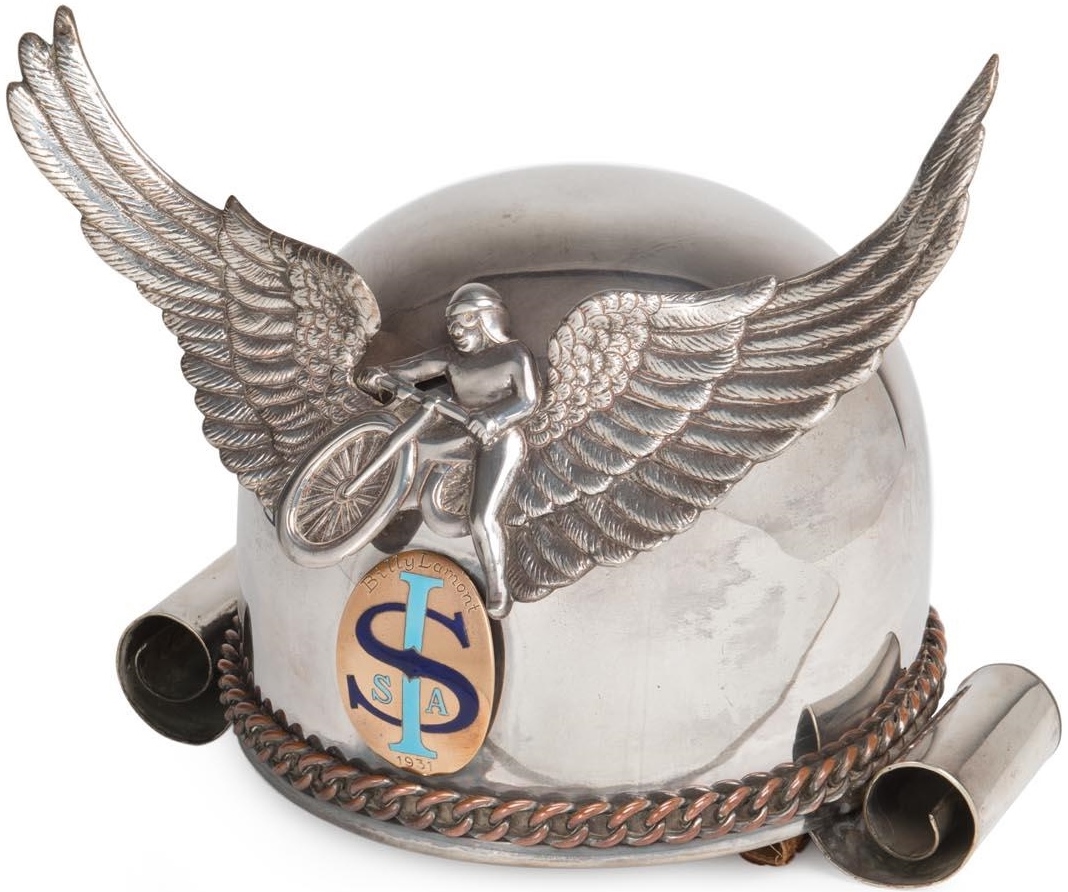
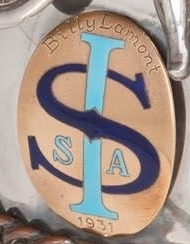
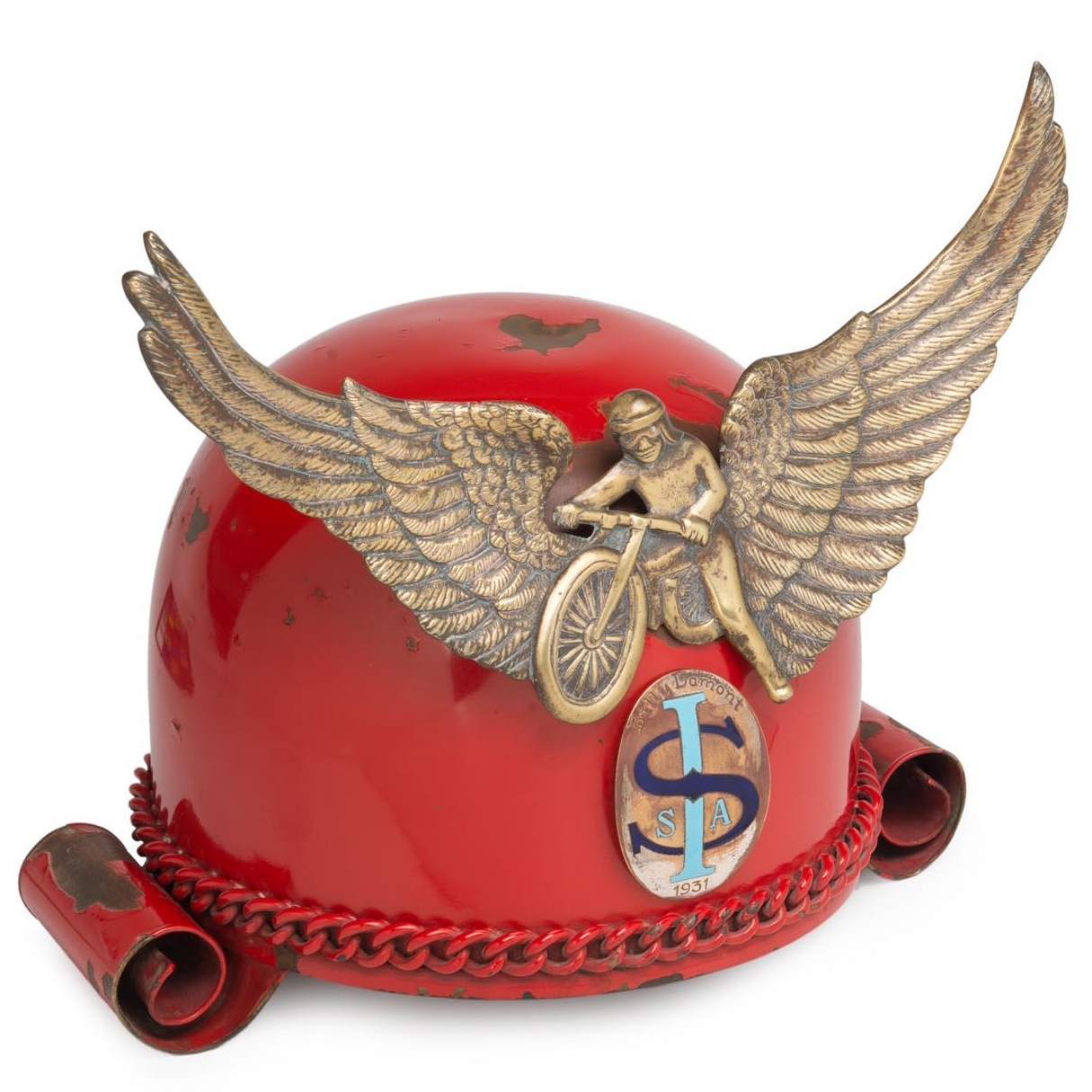
Billy Lamont's Silver Helmet and 'Enamel Helmet' of 1931
Tb.8d
.jpg?timestamp=1643537475707)
- Post-war Australian Golden
Helmets
and New Zealand GHs, pre- &
post-war.
Results of these championships, at tracks such
as Kilburn, Rowley Park, the Showground and Sportsground at Sydney, Ekka, etc,
and the 3 Christchurch tracks, are to be found in tables, image-linked in 8.1 above.
- Australia 1990s
In
Australia the appeal of the name Mauger, Speedway's 'Man of the
Millenium', and his Academy programme of the past 2 decades has
resulted in a Golden Helmet winners' list populated with young
continental Europeans as well as young Australian riders who have since made their presence felt in UK and Europe, filling league places in
Poland and Sweden as well as British Leagues and winning
international championships. Results:are included with Pre- & Post-War Aust. GHs as detailed in 8.1 table above.
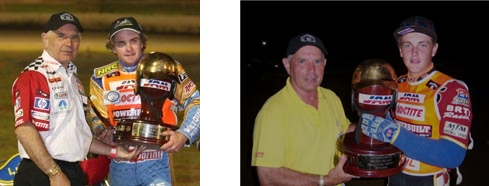
Ivan Mauger and 2 of the 2008 Australian Golden Helmet winners,
Justin Sedgemen & Darcy Ward
- The British Match Race
Championship
The British MRC competition
for the 'Golden Helmet'
was introduced in 1946. See Ch.9, Br. MRC
GH page.
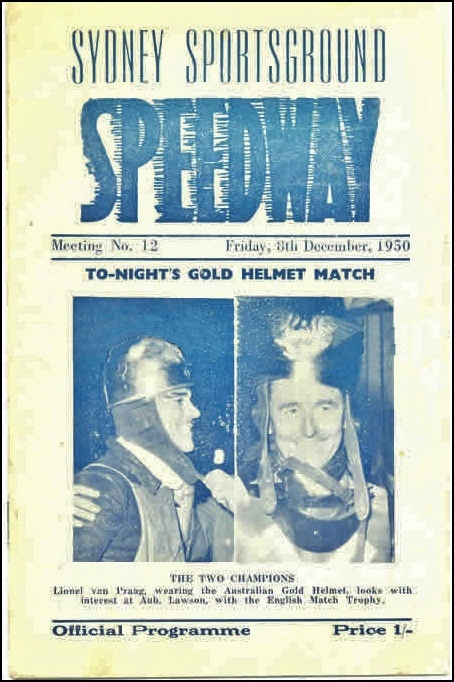
Lionel van Praag wearing the Australian Gold Helmet
meets British GH MRC holder Aub Lawson
in Sydney for the former's title, Sept. 1950.